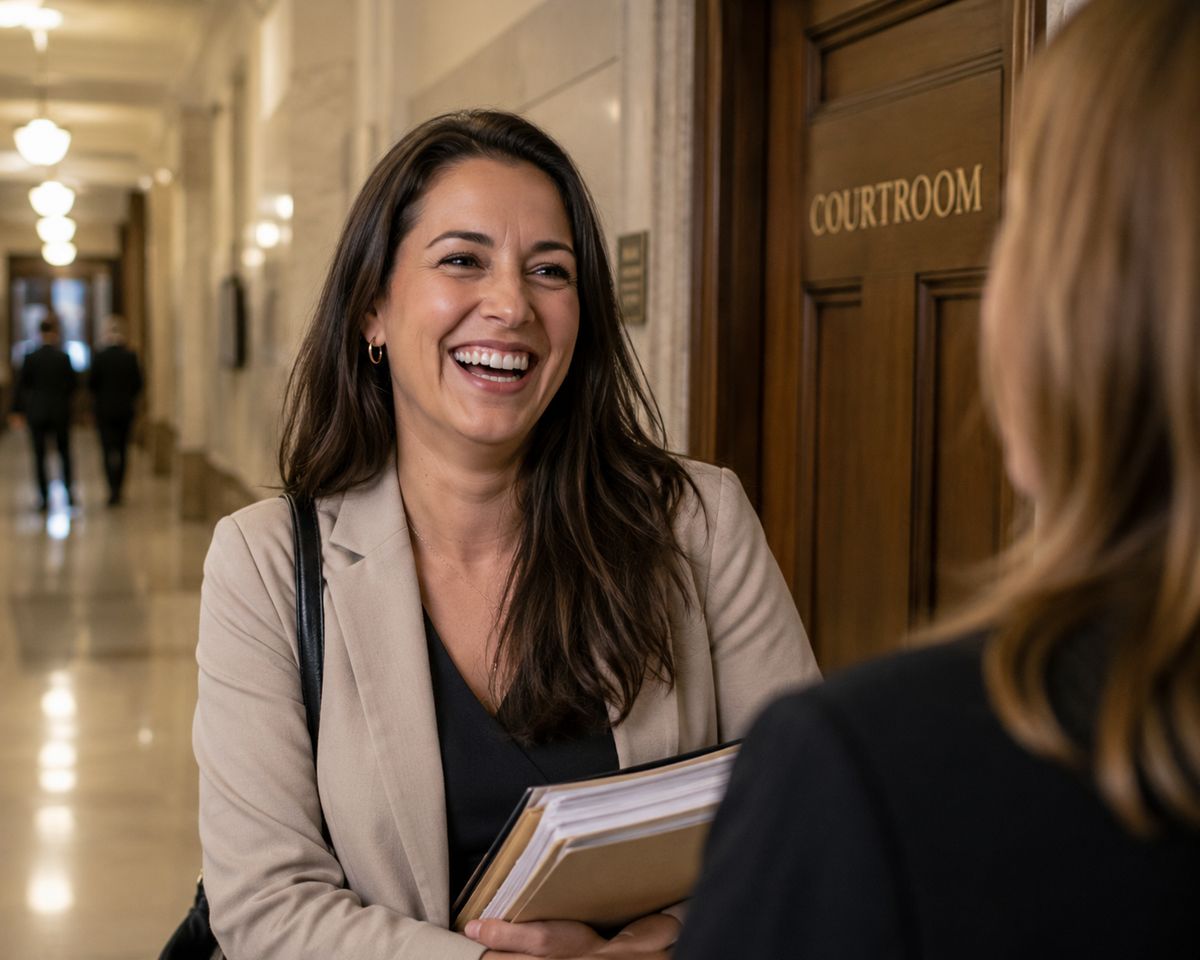
My Sister Called Me 'Legally Stupid' Outside the Courtroom — When I Handed the Judge My Disciplinary Board Credentials, Her Lawyer's Face Turned Pale
June 05, 2026



The judge had sentenced hundreds of criminals, but the moment the defendant entered the courtroom, he froze. Beneath the man’s tired eyes was a face he never thought he’d see again.
The first thing I noticed was the sound of chains.
Not loud chains like in the movies. Just the faint metallic clink of handcuffs as the bailiff guided the defendant through the side door of Courtroom 4B.
I had been reading through sentencing recommendations when the sound pulled my attention upward. It was an ordinary Thursday morning, and I expected another ordinary case.
Fraud.
Theft.
Financial misconduct.
I had seen hundreds of defendants over the years, maybe thousands if I counted arraignments and preliminary hearings.
Most faces blurred together eventually.
But not his.
The moment he stepped into my courtroom, my hands froze above the papers.
Time folded in on itself so suddenly that for a second, I could not hear the courtroom anymore. The lawyers disappeared. The spectators vanished. All I saw was him.
Older now.
Heavier around the stomach.
Gray spreading through hair that used to be golden blond.
The expensive confidence he once carried had been replaced by something sagging and defeated.
Still, I recognized him instantly.
Travis Mercer.
Twenty-three years vanished in a heartbeat.
The bailiff led him to the defense table, and Travis kept his eyes lowered the entire time. He looked exhausted. The kind of exhaustion that settled into a person’s bones after years of losing everything little by little.
I removed my glasses slowly and stared at him.
My clerk leaned toward me. “Your Honor?”
I realized several seconds had passed without me speaking.
“I’m fine,” I said quietly.
But I wasn’t.
Because the man standing before me had once made my life a living hell.
Back in high school, Travis Mercer ruled Stony Brook Academy like he owned the building.
Maybe he practically did.
His father donated enough money to have an entire science wing named after their family. Everyone knew the Mercers lived in the biggest house in Ashford County, sitting on top of a hill behind iron gates that looked like something from a castle.
Meanwhile, my mother and I lived in a cramped apartment above a laundromat on Willow Street.
The pipes rattled all winter.
Sometimes the electricity got shut off because Mom had to choose between paying the power bill or buying groceries.
She always tried to hide how hard things were from me, but kids notice everything.
Especially when they grow up poor.
I was sixteen the first time Travis shoved me into a locker.
I remember it perfectly because my geometry book split open when it hit the floor.
He laughed while papers scattered everywhere.
“Watch where you’re going, Ethan,” he said casually.
His friends laughed behind him.
I knelt down quickly, gathering my papers before anyone stepped on them. My ears burned red with humiliation.
“I said I was sorry,” I muttered.
“You should be,” he replied.
That became our routine.
Almost every day, Travis found some new way to remind me where I stood in the social food chain.
I was skinny, quiet, awkward, and poor. He was everything I wasn’t.
Confident.
Athletic.
Rich.
Loved by everybody.
Teachers adored him because he smiled easily and shook hands like an adult. Parents bragged about him. Girls followed him around the hallways.
And his friends acted like bodyguards, laughing at every cruel thing he said.
One rainy afternoon after school, he grabbed my backpack while I was waiting near the bus stop.
“Careful,” I warned nervously. “There’s homework in there.”
Travis smirked.
Then he tossed the entire bag into a muddy puddle.
The sound of soaked textbooks hitting water still lives in my head.
Everyone around us burst into laughter.
I stood frozen while filthy brown water seeped through my notebooks.
“You should’ve seen your face,” one of his friends choked out between laughs.
Travis grinned at me. “Relax, Ethan. Maybe your maid can clean it.”
They all knew I didn’t have a maid.
They knew my mother worked double shifts at the diner downtown.
That was the point.
I climbed into bed that night pretending I wasn’t crying.
My mother noticed anyway.
“What happened?” she asked softly.
“Nothing.”
“Ethan.”
I stared at the ceiling. “Some kids at school are idiots.”
She sat beside me and brushed hair from my forehead the way she used to when I was little.
“You know what the difference is between you and boys like that?” she asked.
I laughed bitterly. “About ten million dollars?”
“No.” She smiled sadly. “Character.”
At sixteen, that felt meaningless.
Character didn’t stop humiliation.
Character didn’t buy new textbooks.
Character certainly didn’t make people respect you.
The worst incident happened in the cafeteria.
I had exactly four dollars and thirty cents for lunch that week.
I remember counting the coins carefully in line, hoping I had enough for a sandwich and milk.
Travis appeared beside me out of nowhere.
“Well, look at this,” he announced loudly, picking up one of my quarters. “Ethan’s financing a gourmet meal today.”
I reached for the coin. “Give it back.”
Instead, he held it up for the entire cafeteria to see.
“Hey, everyone,” he shouted. “Anybody want to donate to the charity case?”
Laughter exploded across the room.
I wanted the floor to swallow me whole.
Someone tossed a nickel across the cafeteria table.
Then another coin.
People laughed harder.
My face burned so badly I thought I might faint.
Finally, Travis dropped the quarter back into my hand with a grin.
“There you go,” he said. “Don’t spend it all in one place.”
I skipped lunch that day.
And the next.
By senior year, I had mastered invisibility.
Keep your head down.
Stay quiet.
Avoid attention.
That became survival.
The strange thing was that none of it made me hate Travis the way people might expect.
I envied him more than anything.
I envied how easy life seemed for him.
How he walked through the world without fear.
Without worrying about bills or rent or whether his mother could afford groceries.
Meanwhile, I spent evenings studying under flickering lights while Mom slept on the couch after fourteen-hour shifts.
I promised myself constantly that one day, somehow, I would escape.
Not for revenge.
Just to breathe.
Just to live without shame.
Everything changed because of Mrs. Delgado.
She taught civics during my senior year and refused to let me disappear into the background.
One afternoon she stopped me after class.
“Have you ever considered law school?” she asked.
I nearly laughed.
“With what money?”
“There are scholarships.”
“For people smarter than me.”
She folded her arms. “Ethan, you’re one of the smartest students in this school.”
“No one else seems to notice.”
“Then they’re blind.”
That conversation stayed with me.
For the first time in years, somebody saw something in me besides weakness.
Mrs. Delgado helped me apply for scholarships.
She spent hours reviewing essays and applications after school.
When the acceptance letter arrived from Hartwell University with a full scholarship attached, my mother cried harder than I had ever seen before.
“You’re getting out,” she whispered, holding the letter against her chest.
And I did.
College was brutal at first.
I worked nights stocking shelves at a grocery store while carrying full course loads during the day. I survived on instant noodles and caffeine. Sometimes I slept four hours a night.
But for the first time in my life, nobody cared where I came from.
Only whether I could keep up.
So I did.
Then law school.
Then the bar exam.
Then years clawing my way upward one impossible inch at a time.
Assistant district attorney.
Senior prosecutor.
Judge.
Every step took more sacrifice than people ever realized.
And through all those years, I almost never thought about Travis Mercer.
Almost.
Until now.
The prosecutor finished presenting the case details while I sat silently listening.
Fraud.
Embezzlement.
Misappropriation of investor funds.
Millions of dollars missing from a real estate development company Travis had managed.
The evidence appeared overwhelming.
When the prosecutor finished, the courtroom settled into silence.
Travis still had not looked directly at me.
His attorney stood. “Your Honor, my client wishes to make a statement before sentencing.”
I nodded once.
Travis rose slowly to his feet.
His hands trembled slightly.
“I know I made mistakes,” he began hoarsely. “I know people lost money because of decisions I made. I take responsibility for that.”
His voice sounded nothing like I remembered.
Back in high school, Travis spoke with effortless confidence.
Now every word sounded heavy.
“I never intended for things to spiral this far,” he continued. “I thought I could fix it before anyone got hurt.”
The prosecutor looked unimpressed.
I studied Travis carefully while he spoke.
The years had not been kind to him.
Deep lines marked his face. His shoulders slumped as though life itself had physically pressed him downward.
Gone was the king of Stony Brook Academy.
Gone was the boy who laughed while my books floated in muddy water.
When he finally finished speaking, silence filled the room again.
That was when I removed my glasses.
And spoke for the first time since recognizing him.
“I recognized you immediately,” I said calmly. “I don’t know if you recognized me.”
For the first time since entering the courtroom, Travis looked directly into my eyes.
The color drained from his face instantly.
I watched realization hit him like a punch to the stomach.
“Ethan?” he whispered.
Several people in the courtroom exchanged confused glances.
I folded my hands carefully on the bench.
“And there’s something I need to tell you.”
Travis stared at me in complete silence.
So did everyone else.
And suddenly, after twenty-three years, I finally decided it was time to tell him the truth about what happened after high school.
The courtroom remained perfectly silent.
Even the bailiff seemed frozen.
Travis kept staring at me as though he had seen a ghost.
I understood the feeling.
Twenty-three years was a long time to carry unfinished memories.
“I’ve thought about this moment more times than I care to admit,” I said quietly.
Travis swallowed hard but said nothing.
“When I was sixteen, I used to imagine what it would feel like if our positions were ever reversed.”
His attorney shifted uncomfortably. “Your Honor, if this is inappropriate for the proceedings…”
“It’s relevant,” I replied calmly.
The attorney sat back down immediately.
I looked at Travis again.
“You made my life miserable in high school.”
His jaw tightened slightly.
I continued before he could respond.
“You shoved me into lockers. You humiliated me in front of other students almost daily. You threw my backpack into mud because you thought it was funny.”
Several people in the courtroom glanced toward Travis with growing discomfort.
“And one afternoon in the cafeteria,” I said, “you stood there counting my lunch money while people laughed at me.”
Travis lowered his eyes.
“I remember,” he muttered.
“Do you?”
“Yes.”
His voice cracked on the single word.
For a moment, I felt sixteen again.
I remembered the humiliation so vividly that it almost startled me. Memory is strange that way. You can spend decades building a life, becoming someone entirely different, yet one familiar face can drag you backward instantly.
I could still smell cafeteria pizza.
Still hear coins hitting tables.
Still feel the sting of laughter.
The younger version of me had dreamed about revenge sometimes.
Not violent revenge.
Just justice.
Just one moment where Travis Mercer would feel powerless while I stood stronger.
And now here we were.
Life had delivered the moment directly into my hands.
The realization unsettled me more than I expected.
“I convinced myself growing up that I envied you more than I used to hate you,” I admitted.
Travis looked up slowly.
“I know,” he whispered.
“No,” I replied. “I don’t think you do.”
The courtroom remained utterly still.
“I went home some nights wondering what was wrong with me,” I continued. “I thought maybe I deserved it somehow. Kids start believing things when they hear them enough.”
His face twisted with shame.
“My mother worked herself sick trying to keep us afloat. Meanwhile, every day at school, you reminded me how poor we were.”
I paused briefly.
“And the worst part was that nobody stopped you because everyone loved you.”
Travis rubbed a trembling hand across his mouth.
“I was a foul human being,” he said quietly.
The bluntness of it surprised me.
Not because he was wrong.
Because I had never imagined hearing him admit it.
Years ago, Travis had carried himself like someone untouchable. The idea of him apologizing to anyone would have seemed impossible.
“I’ve regretted it for years,” he continued.
I studied him carefully.
People lie in courtrooms every day. I had spent most of my career learning how to recognize deception.
But regret has a certain look to it.
And Travis Mercer looked destroyed by it.
“I tried finding you once,” he said.
That caught me off guard.
“What?”
“About ten years after graduation.” He cleared his throat. “I heard you became a prosecutor.”
I frowned slightly.
“Why would you look for me?”
He gave a weak laugh filled with self-disgust.
“To apologize.”
The answer hung in the courtroom.
“I never did it,” he admitted. “Truth is, I was embarrassed. I kept telling myself it would only make things worse.”
I leaned back slightly in my chair.
“What changed?”
His eyes drifted toward the defense table.
“Life.”
There was something painfully honest in the way he said it.
No self-pity.
No excuses.
Just exhaustion.
“My father lost most of his money after the recession,” Travis explained quietly. “Turns out he was better at spending wealth than keeping it.”
I listened without interruption.
“Then he got sick. Pancreatic cancer.” Travis swallowed hard. “He died fast.”
For a brief second, I remembered Travis as a teenager standing beside his father outside school events. The Mercers had always looked invincible back then.
Rich families are not supposed to collapse.
But life rarely cares about appearances.
“After Dad died, we discovered how much debt he’d hidden,” Travis continued. “The businesses weren’t stable. Investors started pulling out. My mother had never handled finances before.”
The prosecutor shifted impatiently, but I raised a hand slightly without looking away from Travis.
“So you took over the company,” I said.
He nodded.
“At first, I honestly thought I could save it.”
“And then?”
“I started moving money around trying to keep projects alive.” He closed his eyes briefly. “Then I started lying about it.”
The courtroom stayed silent except for the faint hum of the air conditioning.
“One bad decision became another,” he said. “By the time I realized how deep I was, it was too late.”
I had heard versions of this story many times before.
Panic.
Pride.
Desperation.
People rarely wake up intending to become criminals.
Most walk into disaster one compromise at a time.
Still, innocent people had lost money because of him.
That fact mattered too.
“Do you know something strange?” Travis asked suddenly.
I said nothing.
“When I was young, I thought being rich made me better than people.” He laughed bitterly. “Turns out it just made me stupid.”
Nobody reacted.
He looked directly at me again.
“You know the part that haunts me most?”
“What?”
“The cafeteria.”
My chest tightened unexpectedly.
“I still remember your face,” he said softly. “I remember everybody laughing while you just stood there pretending not to care.”
He shook his head slowly.
“I think about that more than anything else I did.”
The room remained so quiet I could hear someone shifting papers in the back row.
“I wanted people to think I was important,” Travis continued. “That’s all it was. My friends laughed, so I kept going further.”
“You humiliated people for entertainment,” I replied evenly.
“Yes.”
The honesty in that answer disarmed me again.
No minimizing.
No excuses.
Just truth.
And somehow that made this harder.
Because hatred is easier to carry when the other person refuses responsibility.
I looked down briefly at the case file in front of me.
Pages of financial evidence.
Victim statements.
Legal recommendations.
Everything required for sentencing.
Yet none of it prepared me for this conversation.
“You know what I realized eventually?” I asked quietly.
Travis waited.
“If I carried hatred for you forever, then you still controlled part of my life.”
A flicker crossed his expression.
“So I let it go.”
I meant that.
Mostly.
The scars remained, but scars are different from open wounds.
“I became a judge because I believed people should be held accountable fairly,” I continued. “Not emotionally. Not personally.”
My voice grew firmer.
“That includes you.”
Travis nodded slowly.
“I understand.”
And I believed he did.
The strange thing was that I no longer wanted revenge.
Sitting there looking at him, I realized revenge had quietly died years ago without me noticing.
Life itself had already punished him far more brutally than any teenager’s fantasy ever could.
The arrogant boy from Stony Brook Academy was gone.
In his place sat a broken man carrying regret like a second skin.
That did not erase what he had done.
But it changed something.
I thought suddenly of my mother.
Of the nights she came home exhausted yet still managed to comfort me.
Character.
That was what she had said mattered.
Not money.
Not status.
Character.
At sixteen, I had not understood her.
At forty-one, sitting behind a judge’s bench across from my childhood tormentor, I finally did.
Power reveals character.
But so does mercy.
I took a slow breath.
“Mr. Mercer,” I said formally, “this court has reviewed the evidence thoroughly. Your crimes caused significant financial harm to multiple victims. Accountability is necessary.”
He straightened slightly.
“However,” I continued, “the court also considers cooperation, acceptance of responsibility, and efforts toward restitution.”
The prosecutor watched closely.
“So here is my sentence.”
Travis held perfectly still.
I sentenced him to reduced prison time contingent upon full financial cooperation, mandatory restitution efforts, and participation in financial ethics counseling programs.
Not because he bullied me.
Not because I pitied him.
But because legally and ethically, it was the correct sentence.
Nothing more.
Nothing less.
When I finished speaking, Travis looked stunned.
“I…” His voice failed briefly. “Thank you, Your Honor.”
I nodded once.
Court procedure resumed.
Papers moved.
Voices returned.
The spell broke.
But before the bailiff led him away, I spoke one last time.
“I thought this moment would feel like revenge,” I admitted quietly. “Instead, it only reminds me how hard I fought not to become cruel.”
Travis lowered his eyes, and for the first time in either of our lives, there was no power between us at all.
My Sister Called Me 'Legally Stupid' Outside the Courtroom — When I Handed the Judge My Disciplinary Board Credentials, Her Lawyer's Face Turned Pale
June 05, 2026

I Paid $650,000 for My Parents' Oceanfront Home — When I Opened the Front Door Months Later, I Nearly Collapsed
June 15, 2026

I Won the House After Our Divorce – But My Ex-Husband's Final 'Gift' in the Backyard Made Me Call My Lawyer
July 03, 2026

The Most Popular Guy in School Asked Me to Prom Just So He and the Prom Queen Could Embarrass Me in Front of Everyone – But My Answer Left Them Both Speechless
June 08, 2026

My Mother-in-Law Announced Her Engagement at My Wedding Reception – Then I Learned Who the Groom Was
June 24, 2026

Nobody Ever Visited Me in the Nursing Home – So I Hired an Actor to Pretend to Be My Grandson, but He Burst Into Tears When He Saw My Old Photo Album
June 30, 2026

My Boss Claimed I Took His Wife's Family Necklace – Until His 12-Year-Old Son Burst Into the Courtroom and Screamed, 'I Know Who Took It, and She's in This Room!'
May 25, 2026

My Brother Told the Judge I Couldn't Afford a Lawyer — Then My Mother's Letter Changed Everything
June 18, 2026
A Strange Elderly Man Recognized My Grandmother's Dress at My Prom – I Wish I'd Never Taken Him to Her
June 01, 2026

My Classmates Mocked Me for Having a 62-Year-Old Mom – At Prom, I Made Them Regret It
June 05, 2026

At My Wedding, a Giant 'Cheater!' Appeared on the Screen Behind My Groom and Me
June 12, 2026