'The Wedding Has to Be Canceled!' the Waitress Shouted During My Wedding Ceremony
July 28, 2026



I thought I was about to catch my husband hiding an affair. Every family photograph in our house had been turned face down, and when he finally came home carrying a suitcase, he looked like a man who'd been keeping a secret. The truth was something I never saw coming.
I knew something was wrong the moment I walked through the front door.
The house felt different somehow, off in a way I couldn't name. I set down my grocery bags to look around. That's when I noticed the photograph on the mantel, turned facedown.
I walked over and flipped it back.
It was our wedding picture.
A second later, I found another, the framed shot from Melissa's college graduation, also turned over, and then another after that. Within a minute, I was moving from room to room, finding the same thing everywhere I looked.
The vacation picture in the hallway, the portrait of our children in the dining room, the photo by the kitchen sink that Michael always joked was older than our marriage.
Even the collage above the staircase.
Every single frame in the house had been flipped face down, and nothing else, not one other thing, had been disturbed.
I stood in the middle of the living room trying to make sense of it.
If someone had broken in, why bother with the photographs and nothing else?
If it was a prank, it wasn't a funny one.
And if Michael had done it, I couldn't begin to guess why.
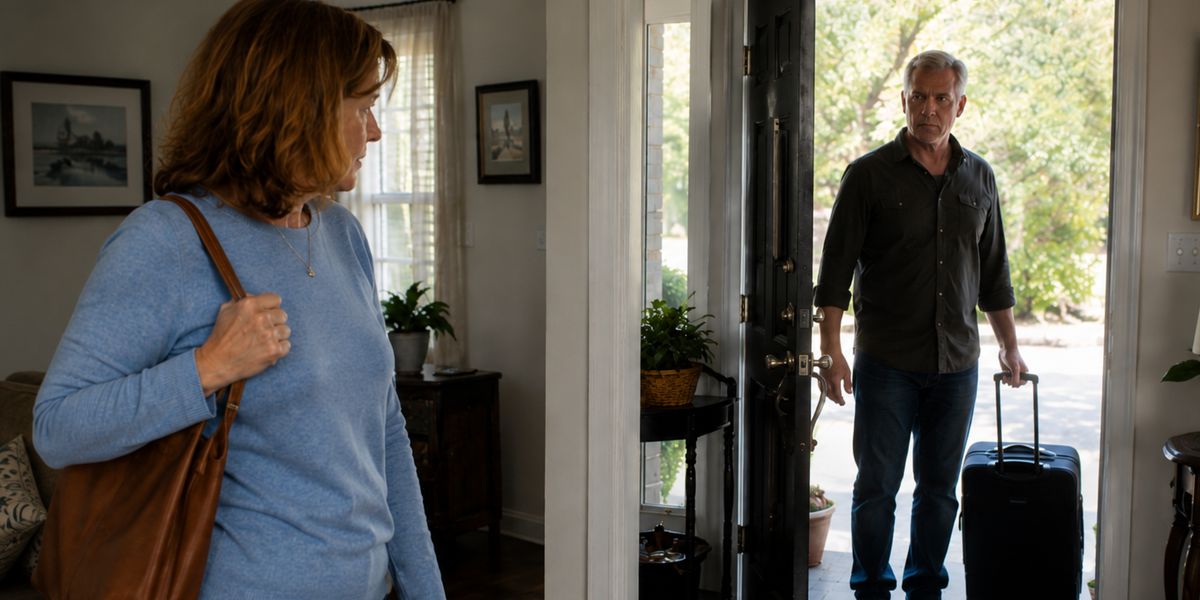
The sound of tires on the driveway pulled me to the front window. A car door closed, and a few seconds later, Michael stepped through the front door carrying a suitcase.
He stopped when he saw me, and for a moment neither of us said anything. Then his eyes drifted toward the photographs, or rather toward the empty spaces where they should have been facing upright.
"You turned them over." It wasn't really a question.
Michael adjusted his grip on the suitcase. "I was going to explain."
The answer bothered me immediately. Most people would have started with a reason. Michael had simply confirmed it and moved straight to the explanation.
I looked at the suitcase properly for the first time, a dark brown leather case, old and worn, not one I recognized. "What's going on?"
Michael glanced away. "Can we sit down?"
The word came out faster than I intended.
"No."
Something shifted in his expression, not anger but something closer to relief, as though he'd expected this conversation to be difficult. That unsettled me more than anything else so far.
"Why are all the pictures turned over?"
"I'll tell you."
"When?"
"Soon."
"Soon?" I stared at him.
Michael set the suitcase down beside the couch. "I just need a minute."
A minute for what, I wondered. To come up with a story, or to decide how much to tell me?
Over the past month, there had been several moments when I'd caught him looking exactly like this, distracted, absent, as though part of him had drifted somewhere else.
At the time, I'd blamed stress. Michael ran a small accounting firm, and tax season always brought long hours and strange moods, but lately it had felt different.
Three weeks earlier, he'd forgotten Melissa's birthday dinner, not the dinner itself but the entire reason we were going. We were halfway to the restaurant before he asked where we were headed, and I laughed because I assumed he was joking.
He wasn't.
A week after that, I found him sitting in his car outside our house after work, parked there for nearly 20 minutes.
When I asked what he was doing, he claimed he'd been finishing a phone call, though the radio was off and the engine wasn't running.
Then there was the note, two words scribbled on a yellow sticky tucked inside his wallet. "Don't forget."
No explanation, no context, just those two words.
At the time, I'd wondered whether another woman had written it, and the possibility embarrassed me now, not because it had ever seemed likely but because I'd never once been the suspicious type.
Michael and I had been married for 28 years.
We'd survived job losses, miscarriages, debt, and the years our children seemed determined to test every limit we set, and infidelity had never crossed my mind until recently.
And now here we were, standing in a house full of photographs turned face down while my husband avoided answering the simplest questions.
"You've been acting strange for weeks."
Michael lowered his eyes. "I know."
"Were you planning to tell me why?"
"I was trying to."
The answer landed badly, like it was trying to imply there was something to tell. I folded my arms. "Is there someone else?"
Michael closed his eyes, not dramatically, more like someone bracing for an impact he knew was coming.
When he opened them again, he still didn't answer, and that was the moment my stomach dropped. It clearly meant something, and whatever it was, he didn't want to say it.
I looked at the suitcase again, then back at him. "What's inside it?"
Michael shook his head. "Kate, please."
"What's inside?"
His hesitation lasted less than a second, but I saw it, and suddenly I was done waiting. I stepped around him, grabbed the handle, and pulled the suitcase onto the coffee table.
Michael stood up. "Please don't."
I ignored him. The case felt heavier than I expected, and up close, the leather looked familiar, worn at the corners, the brass clasps scratched, a faded tag still hanging from the handle.
I froze. I knew this suitcase.
I'd seen it years before, sitting in a corner of Michael's father's garage. My hand stayed on the latch as I looked up at him. "Why do you have your father's suitcase?"
Michael didn't answer. That was when I opened it.
The first thing I saw was paper, dozens of pages, pamphlets, folders, brochures, some brand new and others yellowed with age. I pulled out the first brochure within reach.
The cover showed an elderly couple on a park bench, and across the top, in plain block letters, "Understanding Alzheimer's Disease."
For a second, I just stared at it. Then I grabbed another. "Memory Care Options for Families." Another. "Planning for Cognitive Decline." Another. "Support Resources for Caregivers."
I looked up. Michael hadn't moved. He stood beside the couch watching me, not angry, not defensive, just tired.
"What is this?"
My voice sounded different now, less accusatory, more confused.
I reached into the suitcase again and pulled out a stack of documents bound with a rubber band, paper old enough that the top page carried a date from nearly 20 years earlier.
I recognized the name immediately. Robert. Michael's father. It was a diagnosis report, and behind it came medical notes, treatment recommendations, support group information, pages and pages documenting the final years of his life.
Only then did I notice something strange. Not everything in the case was old. Mixed in among the yellowed pages were brochures freshly printed, with current phone numbers and current facility names.
A local memory care center ten miles away, a neurology clinic, and an assisted living facility I recognized from a television ad.
I looked back at Michael. The pieces weren't fitting together yet, but they were starting to.
"Why do you have these?"
Michael lowered himself into a chair and rubbed his hands together as though trying to warm them. "Because I went looking for them," he said finally.
"For what?"
Michael glanced at the old paperwork.
"Answers."
He picked up one of the folders.
"After my father died, I never looked at any of this. Not once"
His fingers rested on the cover.
"A month ago, I started noticing things."
The words pulled me straight back to every strange moment I'd been replaying for weeks, the birthday dinner, the note, the long silences, the distraction.
At the time, I'd been searching for one explanation. Now I wasn't sure I'd been looking for the right one.
Michael glanced toward the fireplace, toward the wedding photograph I'd just turned upright.
"A month ago, I forgot where I'd parked my car."
I almost interrupted, because everyone forgets where they parked, but something in his expression stopped me. "It took me 40 minutes to find it."
His voice stayed calm, almost too calm. "I thought it was stress." He looked down at his hands. "Then I forgot a client's name."
That wasn't like Michael, not even close. He remembered birthdays, phone numbers, and addresses from houses we'd lived in 20 years earlier.
His memory was something the whole family joked about. Melissa used to call him the human filing cabinet.
"Then I forgot the route to a restaurant I've been going to for 15 years," he said.
I said nothing.
Because suddenly I remembered the dinner reservation he'd missed, and the night I'd found him sitting outside in his car for 20 minutes. He hadn't looked guilty either time.
He'd looked lost, and at the time, I'd read both moments completely wrong.
"I made an appointment," Michael said. "Then another." His eyes moved toward the suitcase. "And another."
I already knew where the story was heading, and part of me didn't want him to finish even as the rest of me needed him to. Finally, he leaned forward.
"There was a diagnosis."
The words settled heavily between us, impossible to ignore.
I stared at him, then at the suitcase, then at the brochures spread across the table, and everything suddenly looked different.
The photographs, the distractions, the silences, the note that said don't forget, none of it had been about someone else. He'd written it for himself.
"When?" My voice came out softer than before.
"A month ago."
Four weeks. Four weeks of carrying this alone, four weeks of pretending everything was normal.
I looked at the diagnosis papers again.
Most of them were his father's, but then I noticed an envelope near the bottom of the case, white and seemingly unopened. Michael followed my gaze. "I should probably explain that too."
I pulled it free. The return address belonged to a neurology clinic. My hands hesitated for a second before opening it. The letter inside wasn't long, and it didn't need to be.
The words that mattered appeared in the second paragraph, and I read them twice, then a third time, as though repetition might somehow change them.
When I finally looked up, Michael was watching me, not waiting for sympathy but for me to catch up to the reality he'd already been living with for a month.
"Why didn't you tell me?"
Michael laughed quietly. "I tried."
"When?"
"About 20 times." I frowned, and he looked away. "I'd start the conversation in my head, and then I'd imagine your face." A sad smile crossed his lips.
The answer hurt more than I expected, because I understood it, not completely, but enough. "You thought I'd fall apart."
"I thought I would."
Neither of us spoke for a moment. My eyes drifted back over the suitcase, the old paperwork, the newer brochures, the handwritten notes, and it struck me that it looked less like a suitcase and more like a timeline, his father's future and possibly his own laid out side by side.
"What were you doing today?"
Michael leaned back. "I went to my father's storage unit. I found all the things he kept after his diagnosis." His eyes moved toward the stack of aging papers. "I wanted to know what he was thinking."
The statement caught me off guard. "What do you mean?"
"When he got diagnosed." Michael paused. "For years, I only saw the end, the nursing home, the confusion, all the difficult parts. I never thought much about the beginning."
Now I understood. Today hadn't really been about research. It had been about finding someone who'd already walked this road ahead of him.
Michael reached toward one of the folders and pulled out his father's handwritten notes, pages of them filled with questions, reminders, observations, some practical and some heartbreaking.
One line had been underlined several times.
"Tell them while you still can."
Michael stared at it. "I must've read that line 30 times today."
I looked down at the brochures spread across the coffee table.
A few minutes earlier, I'd been searching for evidence of a betrayal. Now I was staring at something far more frightening.
There was still one question I hadn't asked, and it kept pulling me back to the photographs. I looked toward the mantel, toward the wedding picture, then back at him.
"Why did you turn them over?"
Michael didn't answer right away. For the first time all evening, he seemed unsure where to begin.
Finally, he stood, walked to the fireplace, and picked up the wedding photograph, turning it over in his hands for a few seconds before he spoke.
"I was standing here this morning," he said, "right where you are." I followed his gaze toward the mantel. "The picture caught my attention. I don't even remember why, maybe I was already thinking about my father, maybe about the appointment. I picked it up and looked at it."
His voice stayed steady. "Then I started trying to remember where it was taken."
I smiled faintly. "Our honeymoon."
"I know that now."
The word now stayed with me. Not then. Not immediately. Now.
Michael sat back down. "I knew it was important. I knew it was us."
He paused.
"But I couldn't remember where. I just stood there staring at it." His eyes drifted toward the picture again. "Five minutes."
The number hit harder than I expected, not because five minutes was particularly long but because I knew Michael, the man who still remembered his locker combination from high school, who could recite old phone numbers he hadn't dialed in decades.
For him, five minutes would have felt like an eternity.
"When it finally came back to me, I felt relieved." He gave a small laugh. "Then I looked at another photo, and the same thing happened."
The graduation picture, the vacation photo, the family portrait, one after another, not forgotten exactly, but delayed, uncertain, slipping just out of reach.
"I started testing myself," he said, looking at me apologetically, "as if proving I could still remember would somehow change anything."
The explanation made painful sense. Michael had always been a problem solver, the kind of person who believed every challenge could be fixed if you worked hard enough, and this was the first problem he'd ever faced that couldn't be negotiated with.
"I kept looking at pictures," he said, his voice growing quieter, "waiting to see if the memory came immediately."
I understood now.
The photographs hadn't been turned over out of anger or shame or resentment. They had become exams, and every delay had felt like a failed answer.
"When did you decide to turn them around?"
Michael stared at the floor. "When I realized I was afraid of them."
That answer stayed with me, not because it was dramatic but because it was honest. For 28 years, those photographs had represented our life together. Now, for him, they represented something else, a question he could no longer trust himself to answer.
Michael reached toward the suitcase. "I drove to my father's storage unit after that," he said, pulling out one of the older folders.
"The diagnosis brought back memories I'd spent years avoiding."
I nodded. His father's illness had consumed the final years of his life, and by the end, Robert had mistaken Michael for his brother, for a nurse, sometimes for a complete stranger.
Those years had been hard on everyone, especially Michael.
"I kept wondering if he felt this scared," Michael said, his eyes moving toward the old paperwork, "whether he spent weeks pretending everything was fine." He smiled sadly. "Turns out he did."
He opened one of the folders to show me the handwritten pages inside, dozens of them, his father's handwriting growing shakier the deeper into the stack he went.
The first pages looked steady. The last ones didn't, and I didn't need to read them closely to understand what that meant. "I spent hours reading everything," Michael said, running a hand through his hair.
"Then I started visiting facilities."
There it was, the brochures, the appointments, the notes, all of it finally making sense. "I wasn't planning to move into one," he added, smiling faintly. "I know that's probably what this looks like."
I almost laughed, because that was exactly what I'd thought. "I just needed to feel like I was doing something," he said, and that sentence explained more than anything else had.
All day he'd been moving, driving, researching, comparing, trying to create order where none existed, trying to prepare for a future that refused to be prepared for.
"I kept imagining scenarios," he said, looking down. "What if things progress quickly. What if they don't. What if I become a burden." The last question lingered longer than the others.
I leaned forward. "Michael." He looked up.
"You are not a burden."
His expression changed immediately, not because he believed me but because he wanted to. There was a difference.
"I watched what happened to my father."
"I know."
"I watched my mother lose pieces of him for years."
He looked away.
"And I don't want that for you."
There it was, finally, the real fear. Not the diagnosis itself, not even the disease, but what it might do to the people he loved.
For weeks, I'd been convinced he was pulling away from me. Now I understood he'd been trying to protect us from something he couldn't control, and the irony was almost painful: the more frightened he became, the more alone he'd made himself.
I looked at the suitcase again, a month of fear hidden inside folders and envelopes.
Then I looked at my husband, the same man I'd spent nearly three decades building a life with, who still remembered every anniversary, still knew exactly how I took my coffee, still reached for my hand during movies.
The diagnosis hadn't changed who he was. It had only changed what he feared.
"You should have told me."
Michael nodded. "I know."
"You don't get to carry this alone."
He looked down at the table. "I know."
This time I believed him, not because he agreed but because he looked exhausted, as though he'd finally set down something impossibly heavy he'd been carrying alone.
After a while, we began putting the photographs back, one at a time, and neither of us suggested leaving them facedown.
Now I understood what I'd walked into that afternoon.
Fear had moved through our house that morning, turning over every photograph, packing a suitcase, and convincing my husband he had to carry this alone.
That night, we sat at the kitchen table long after dinner, sometimes talking, sometimes just sitting in the quiet together.
We looked through his father's old notes, read the names of support groups, made lists of doctors, and crossed a few facilities off the ones he'd visited.
We didn't have any answers yet. What we had, finally, was a conversation.
Around midnight, Michael pulled the folded sticky note from his wallet, the same one I'd noticed weeks earlier. "Don't forget." He looked at it for a moment before handing it to me.
"I wrote this after the diagnosis."
I turned it over and found more writing on the back, smaller and more hurried. "Tell Kate tomorrow." I looked up. Michael smiled sheepishly. "I carried it every day."
He smiled weakly.
"Every morning I thought I'd tell you that night."
"Then I'd decide I needed one more day. Tomorrow kept moving."
For the first time that evening, I laughed, a real laugh, the kind that sneaks up on you before you notice it coming. Michael laughed too, then reached across the table and took my hand.
The future still frightened me, and it probably always would.
There would be appointments, decisions, good days and difficult ones, things neither of us could predict. But sitting there looking at the man I'd nearly accused of having an affair only a few hours earlier, one thing had become clear.
The diagnosis had never been what scared him most. It was the thought of facing it alone, and for the first time in a month, he wasn't.
The next morning, sunlight caught the wedding photograph on the mantel. Michael glanced at it while pouring coffee, then smiled. "Hawaii."
I looked up. "What?"
He pointed toward the picture. "Our honeymoon."
I smiled back. "I know."
He nodded, and after a second added, "So do I."
For the first time in a month, Michael wasn't trying to face the future by himself.
And somehow, that felt like a beginning.
Did this story tug at your heartstrings? Here's another one you might enjoy: My children disappeared for fourteen days without a trace. When my son finally returned, he carried an old suitcase that belonged to someone I thought was gone forever. By the time I opened it, the mystery had become far bigger than their disappearance.
'The Wedding Has to Be Canceled!' the Waitress Shouted During My Wedding Ceremony
July 28, 2026

I Never Married or Danced with Another Man After My High School Sweetheart Disappeared on Prom Night in 1985 – Last Week, a Little Girl Handed Me His Prom Boutonniere
August 04, 2026

My Son Organized a Charity Dinner for His Less Fortunate Classmates – The Next Morning, We Found a Mysterious Box on Our Doorstep
June 29, 2026

My Husband Left Me After My Stroke – He Returned a Year Later as I Let Go of What He Thought I Could Not Live Without
June 25, 2026

My Late Father Left Me Tickets for a Caribbean Cruise in His Will – On the Fourth Day, a Woman Sat Down at My Table and Handed Me a Letter in His Handwriting
July 28, 2026

I Fed My Neighbor's Son Almost Every Day Throughout His Childhood Years – 20 Years Later, He Was on My Porch with a Box
August 07, 2026

I Took the Cruise My Late Husband and I Had Saved for over 30 Years – On Day Five, the Captain Called My Name and Told Me to Look Under Table Seven
July 13, 2026

After My Father's Funeral, His Hospice Nurse Said, 'He Asked Me to Wait Until Today Before Telling You What Really Happened the Night Your Daughter Disappeared'
July 31, 2026

My Husband Insisted on Sleeping in a Separate Hotel Room on Our 20th Anniversary Trip – I Cried When I Learned the Real Reason
August 10, 2026
My Sister Made Everyone Believe I Abandoned Our Father After His Stroke – Then His Will Forced Me to Open a Locked Cabinet and Give Her a Box She Never Expected to See Again
June 18, 2026

I Was Waiting for My Fiancé at the Altar for an Hour – But Instead of Him, a Courier Walked In Carrying a Baby
July 23, 2026